Get support for student success - right in your inbox
NHLI | New Hampshire Learning Initiative
All Students Deserve a Quality Education
/ December 29, 2025
Student Agency Part 2: Trusting Students in the Kitchen
My understanding of student agency first took root during my graduate teaching program at Simmons University. In a curriculum design seminar, a group of us were discussing the role of the teacher. One student offered an analogy: teaching, she said, was like being a chef—it’s the teacher’s job to carefully select the ingredients and prepare a meal for students to consume, much like choosing the resources, lessons, and activities for the year. Another student challenged that idea. What if, she suggested, students were the chefs? What if they had a voice in selecting the ingredients, experimenting with combinations, and creating a dish of their own design?
That simple but profound shift in perspective resonated deeply with me and became the foundation for how I think about student agency.
Student agency is fundamentally about power. As Wenmoth, Jones, and DiMartino (2021) describe it, “Learner agency is about having the power, combined with choices, to take meaningful action and see the result of those decisions. It can be thought of as a catalyst for change or transformation.” That definition captures what I sensed in that classroom conversation years ago: agency is not about abandoning structure or expectations, but about positioning students as active decision makers in their own learning.

As a teacher, and later as a school and district administrator, I began to view my role differently. If students are meant to take meaningful action, then my job was not simply to design experiences for them, but to create conditions with them. This required letting go of some control and trusting students to wrestle with uncertainty, make choices, and learn from the outcomes of those choices. It also meant recognizing that agency is developmental. It must be taught, practiced, and supported over time.
I was reminded of this truth through our work on the New Hampshire Learning Initiative Student Agency Project, a statewide initiative involving 12 member schools and over 130 students. Through this project, students lead meaningful work that matters to them and their school communities.
This year marks an important milestone. For several schools, it is their second year participating, and students are now preparing to launch the projects they designed in year one. When students first started the project, they were invited to take ownership in ways that initially felt unfamiliar. After a year of using design thinking strategies, teams were able to identify real problems, design solutions, set goals, manage timelines, and reflect on their learning throughout the process. They also employed Agile Scrum to collaborate and manage their time.
Not surprisingly, many teams initially struggled with autonomy. Accustomed to being told what to do, students often look for reassurance or the “right” answer. Agency, after all, is not something students automatically possess simply because we offer it; it must be intentionally developed, practiced, and supported.
Over time, however, the shift is powerful. Students begin asking deeper questions. They collaborate more intentionally with peers and adults. They articulate why their work matters and how it connects to their school communities and beyond. For students returning for a second year, the growth is even more visible. These learners move more quickly from idea to action and often support newer participants as emerging leaders.
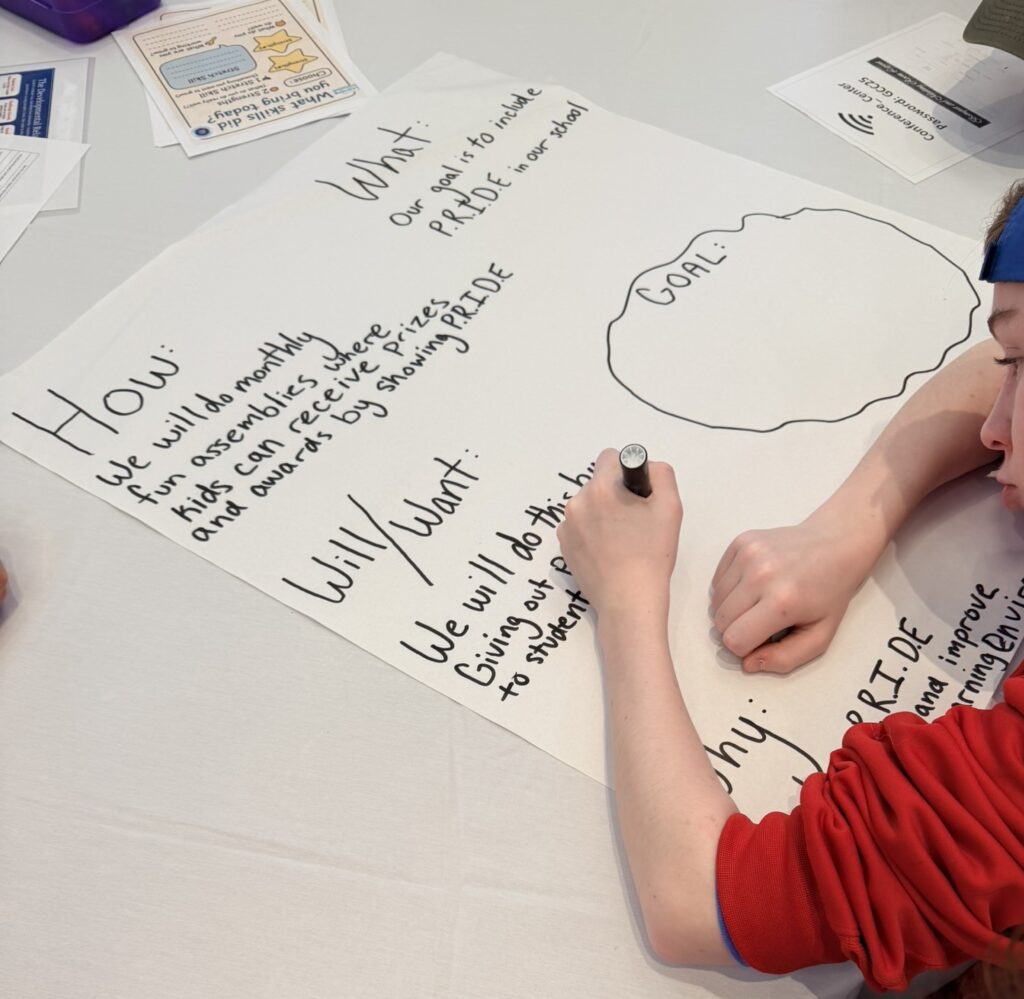
Teams that are in year two, the launch year, have identified projects that reflect the issues students experience every day in their schools. One school is taking on the work of reimagining their school mascot, so it is culturally appropriate and inclusive, with the goal of uniting students and increasing school pride. Another school team is concerned about the lack of engagement they see in their classes and is advocating for expanded project-based learning opportunities, drawing on their own experiences in the classroom to propose instructional changes. A K-8 school is designing a student buddy system that pairs older and younger students to support transitions and create a stronger sense of community and belonging among students.
In each case, student teams are doing more than offering ideas or responding to choices presented to them. Instead, they are using their power and creativity to shape the environments they learn in for the benefit of all students.
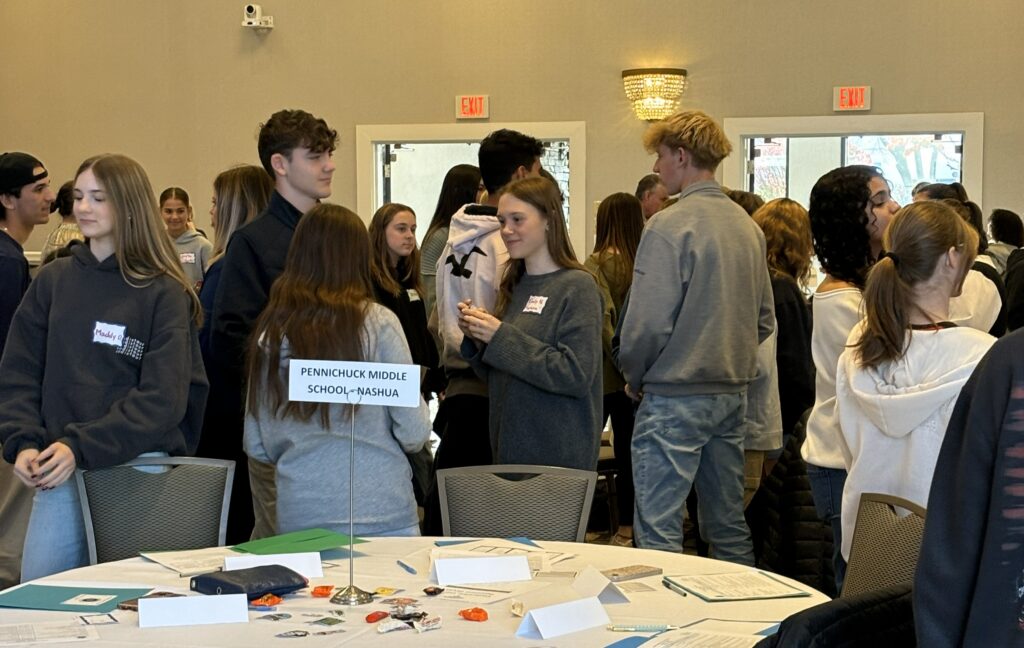
What this project continues to reinforce for me is that student agency grows when we, as educators, are willing to trust students with real responsibility. It also requires us to lead differently—to step back, share control, and ultimately relinquish some of our power to students. Agency is also not a single moment or a one-time opportunity; it’s built through repeated practice. Students need opportunities to practice making decisions about their learning and setting goals. Adults, in turn, need to practice engaging students in decision-making rather than directing it.
I still think often about that chef analogy from my graduate school days. I imagine schools and classrooms as kitchens where students are encouraged to experiment, adjust when something doesn’t work, and create something that reflects their thinking and identity. The teacher is still there, guiding, coaching, ensuring safety, but no longer controlling every step.
That image has stayed with me because it captures what true student agency looks like. It’s time we trust students in the kitchen, not just to follow the recipe, but to write their own.

Ann Hadwen
Director of Educator Development and Coaching
Ann brings 30 years of experience in education to NHLI. Ann's career spans roles as a 6-12 social studies teacher, building- level administrator, and district curriculum administrator. Ann uses her expertise as an instructional leader to empower educators to initiate and sustain positive change for the success of each learner. She has extensive experience with competency-based learning and school redesign, and has presented at numerous local and national conferences. Ann received her undergraduate degree in Political Science from the University of Portland (Oregon), a Master's degree in Teaching from Simmons College, a Master's degree in Administration from Rivier University, and an Ed.S. degree in Administration and Supervision from the University of New Hampshire. She lives in southern New Hampshire with her husband and twin boys.
Categories: NHLI Student Agency Project Project-Based Learning Student Agency