Get support for student success - right in your inbox
NHLI | New Hampshire Learning Initiative
All Students Deserve a Quality Education
/ March 3, 2026
Making Math Spicy
6-12 Math Educators Collaborate at NHLI’s PLACE
Estimated reading time: 5 minutes
This is second in a series of blog posts sharing about the incredible work PLACE educators are doing. You can read the first post, ELA in Action, here.
Back when I was in school, math class followed a familiar daily routine: sitting at a desk, listening to a lecture, watching the teacher work through sample problems, and then spending about 30 minutes working through a similar problem set on my own. After that, there was time to ask questions—if any—and then to finally start on homework. I worked feverishly to get through as many problems as possible, so I wouldn’t have to lug the heavy textbook home with me. And, of course, I skipped the word problems at the end. Those required too much writing—and too much thinking.
Math instruction has changed a lot since then. Last week, I was fortunate enough to spend a day with a group of New Hampshire math teachers who are part of the New Hampshire Learning Initiative’s Performance Learning and Assessment Consortium for Educators (PLACE). Teachers who participate in PLACE attend workshops throughout the year focused on student-centered math instruction and assessment. These workshops are facilitated by practicing math teachers who have been researching instructional practices that maximize student engagement and mathematical thinking.
The workshop began the same way these teachers begin class with their own students. Participants were randomly assigned to groups and positioned at vertical whiteboards, requiring everyone to stand together and work collaboratively in a shared space. Tyler Nutter, a high school math teacher, led this part of the workshop. He opened with a group discussion about palindromes, asking teachers to recall ones they were familiar with. “Race car!” and “Taco cat!” were quickly shouted out.
I’m still not completely sure how they did it!
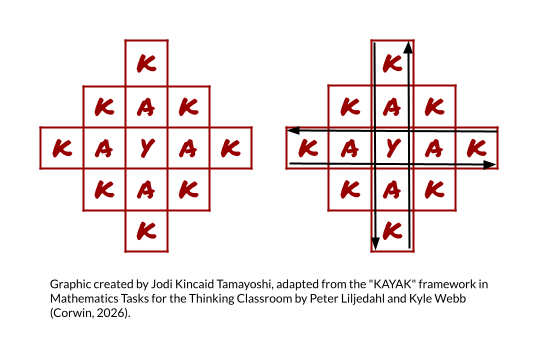
Next, Tyler gave the group the word kayak to work with. This task came from Mathematics Tasks for the Thinking Classroom, Grades 9–12 by Peter Liljedahl and Kyle Webb. The teachers had to determine how many times the word kayak could be formed using all of the letters in the word by connecting it—acrostic-style—to another kayak. (Additional Ks and As were added into the corners of the diagram.) Groups worked through the problem by discussing possibilities, laughing, questioning, erasing, and trying again. In the end, each group approached the task differently and explained their reasoning, with one group landing on the correct solution (I’m still not completely sure how they did it!).
[Students] need to be comfortable with challenging problems that don’t have simple, tidy solutions.
The point of the exercise wasn’t just finding the correct answer; it was the act of problem-solving itself—communicating ideas, collaborating with others, and building the stamina to tackle complex problems. These are all qualities we want students to develop. For the record—spoiler alert—the answer was 144, and I wasn’t even close.
The world students are entering today requires them to develop skills that go far beyond simply solving for x. They need to be comfortable with challenging problems that don’t have simple, tidy solutions. Equally important are the abilities to work collaboratively and to clearly communicate their thinking and solutions.
After the introductory problem opener, the larger group was divided into smaller middle school and high school groups. I chose to stay with the middle school group, although both groups were exploring the same instructional strategy: thin slicing. Thin slicing, a strategy described by Peter Liljedahl in Building Thinking Classrooms, intentionally sequences tasks so complexity builds slowly, with each problem in a set varying by just one element.
The goal of thin slicing, according to Lilijedahl, is to keep students in a state of flow, where the level of challenge matches their current ability. If a problem is too challenging at the start, it can lead to frustration; if it’s not challenging enough, it can result in boredom and disengagement. As each problem becomes slightly more complex, the student’s ability grows, prompting the next, more challenging task. When students are supported in this way, they are more likely to stay engaged and persist through difficulty, rather than becoming frustrated or avoiding the work, much like my middle school self did with word problems.
Middle School teachers Heather Rogers and Tara Schneider introduced their approach to thin slicing using chili peppers as a visual metaphor. They present students with problems at varying levels of difficulty, labeled with different-colored peppers: green represents a mild, entry-level problem; orange signals a medium, more challenging problem; and red indicates a spicy, most-difficult problem. Students can choose where they want to begin and may move to an easier or more challenging problem at any time.
Once students complete the problem they have selected, they are given the next, slightly more challenging problem in the sequence. Using this strategy, teachers can move students through the math curriculum at a much more responsive—and often faster—pace than when all students are working on the same problem level.
The challenge of creating this kind of engagement and deep thinking in math classrooms is exactly why this group of teachers has been working together for the past few years. Through the NH PLACE program, sponsored in partnership with NEA-NH, teachers from across the state have opportunities to meet throughout the year to learn, share ideas, and collaborate. The goal is simple: to make math more engaging and more connected to the skills students need beyond school. As one teacher put it, “I always like talking with other math instructors. That will forever be my favorite part of a workshop.”
Watching teachers engage in this kind of thinking around math instruction reminded me how different math classrooms can—and should—look today. As one teacher explained, “It is hard to change what I have done for 30 years.” However, “this shift (in instruction) is important and beneficial.” Learning experiences like these help students develop problem-solving, collaboration, and communication skills they will rely on throughout their lives, no matter where their paths lead.
Workshop Resources:
Liljedahl, Peter, and Kyle Webb. Mathematics Tasks for the Thinking Classroom, Grades 9–12. Corwin, 2026.
Liljedahl, Peter. Building Thinking Classrooms in Mathematics: Grades K–12, 14 Teaching Practices for Enhancing Learning. Corwin, 2021.

Ann Hadwen
Director of Educator Development and Coaching
Ann brings 30 years of experience in education to NHLI. Ann's career spans roles as a 6-12 social studies teacher, building- level administrator, and district curriculum administrator. Ann uses her expertise as an instructional leader to empower educators to initiate and sustain positive change for the success of each learner. She has extensive experience with competency-based learning and school redesign, and has presented at numerous local and national conferences. Ann received her undergraduate degree in Political Science from the University of Portland (Oregon), a Master's degree in Teaching from Simmons College, a Master's degree in Administration from Rivier University, and an Ed.S. degree in Administration and Supervision from the University of New Hampshire. She lives in southern New Hampshire with her husband and twin boys.
Categories: Competency-Based Education Math PLACE (Performance Learning and Assessment Consortium for Educators) Teacher Professional Development