Get support for student success - right in your inbox
NHLI | New Hampshire Learning Initiative
All Students Deserve a Quality Education
/ September 25, 2026
Why Project-Based Learning (PBL)? Because Learning Should Matter.
Estimated reading time: 4 minutes
We can create a beautifully planned lesson and align it perfectly to standards or competencies. We can have the right learning targets, materials, and assessment. But if students don’t see a reason for the work beyond because the teacher assigned it, we are missing an opportunity.
Students know when the work they are doing matters—and they definitely know when it doesn’t.
PBL Gives Students a Reason to Learn
PBL has never been about doing a “fun project” at the end of a unit. It isn’t about posters, presentations, or adding something creative after the real learning is finished.
The project IS the learning.
A strong PBL experience starts with a meaningful problem, challenge, or question. Students have a reason to learn the content because they need that knowledge to accomplish something. Instead of asking, “Why do I have to know this?” they begin asking, “What do I need to know to figure this out?”
That shift changes the classroom culture—and it changes the teacher’s role.
The teacher is still teaching. In fact, quality PBL requires incredibly intentional teaching. But the teacher is not responsible for holding all the information and telling students exactly what to do with it. Instead, we create the conditions for students to investigate, problem-solve, make decisions, get stuck, revise, and try again.
PBL also creates space for real student voice and agency. Students make meaningful decisions about how they approach a problem, what questions they investigate, how their team works together, what they create, and how they respond to feedback. Over time, students begin to see themselves as people who can contribute—not simply people who complete assignments.
And yes, PBL is messy. Things don’t always go according to plan. Students may take a project in a direction we didn’t expect. Groups may struggle. An idea that sounded great on paper may not work once students get into it. Sometimes we realize students need more support or instruction than we originally planned.
That messiness is exactly what makes PBL valuable.
Outside of school, what we do rarely comes with perfect directions and a set amount of time to finish. We ask questions. We work with other people. We adjust when something isn’t working. We listen to feedback and try again. PBL gives students a place to practice all of this while working toward something with purpose.
Teachers Need to Experience PBL, Too
Teachers do not need a shiny new binder labeled PBL on their shelf. They need to experience the process themselves. They need time to think about their own students, content, competencies, and school communities—and support in designing something that will actually work in their classroom.
That is an important part of how we approach PBL professional learning at New Hampshire Learning Initiative.
We don’t believe there is one PBL template every teacher should follow. A kindergarten PBL experience shouldn’t look like a tenth-grade PBL experience. A high school science project shouldn’t look like an elementary literacy project. And what works in one school or district may need to look very different in another.
The framework matters. The quality matters. But context matters, too.
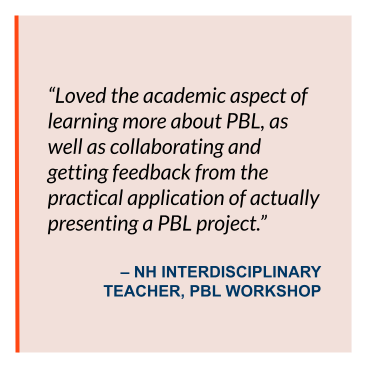
During our three-day summer PBL institute, teachers explore the elements of high-quality PBL while actually designing. They develop driving questions, consider authentic audiences and products, build in student voice and choice, and think about sustained inquiry, critique, revision, reflection, and team management.
But just as important, students have time to work. They struggle. They get feedback. They revise. They ask questions. They rethink ideas. And then they work some more. The goal is not for teachers to leave saying, “I learned a lot about PBL.” The goal is for them to leave saying, “I have something I can actually use with my students.”
PBL Doesn’t Have to Start With a Complete Redesign
Some of my favorite work happens when NHLI partners directly with a school or district because we can design a custom experience for the teachers and students in front of us.
We work with the competencies teachers already use, review existing units and assessments, and consider the communities they serve. Instead of starting over, we start with something teachers are already doing and ask:
How could we make this more authentic?
Sometimes that leads to a full PBL unit. Sometimes it leads to a smaller shift—an authentic audience, a real-world problem, more student choice, a meaningful product, or an opportunity for students to get feedback and revise their work.
Often those smaller shifts are exactly the right place to begin. Find out more about NHLI’s hands-on PBL workshop and how to register on our Events & Training page.

Bari Boisvert
Director of Student-Centered Learning
Bari Boisvert is the Director of Student-Centered Learning at the New Hampshire Learning Initiative (NHLI). She brings over 26 years of classroom teaching and instructional leadership to her role, specializing in Project-Based Learning (PBL), competency-based education, and performance assessment design. A former Sanborn Regional High School English teacher, Grade 10 ELA Content Lead for NH-PACE, and Design Lead for NH ELA PLACE, Bari works directly with educators across New Hampshire to build authentic, empowering learning environments.
Categories: Academic Competencies Agile Classrooms Educational Best Practices Innovative Teaching Practices NHLI Blogs NHLInsights, Research and Resources Project-Based Learning Student Agency Student Engagement Student-Centered Learning Teacher Professional Development