Get support for student success - right in your inbox
NHLI | New Hampshire Learning Initiative
All Students Deserve a Quality Education
/ September 15, 2026
Sensemaking in the Science Classroom: How Learning Happens
Estimated reading time: 5 minutes
As science teachers, we want our students to be curious, thoughtful, and willing to wrestle with challenging ideas. We want our students to leave our classrooms believing, “I can figure things out”. The pressure to cover content and keep pace has teachers relying more on explaining than discovering. What would happen if we designed science learning around the way people actually learn something new?
Think for a moment about the last time you learned something on your own. Maybe you learned a new game, figured out how to use a piece of technology, tackled a home project, or tried something you had never done before. Chances are, you did not begin by asking someone to give you all the information you might need. You encountered something you wanted to understand, recognized what you did not know, sought out what you needed, tried different approaches, and adjusted along the way. Understanding developed gradually as you made sense of the experience.
It all begins by tapping into students’ curiosity. Curiosity is more than a nice addition to learning; it can create the conditions that make students want to know more. As Stenger (2014) notes, “People are better at learning information they are curious about, as curiosity prepares the brain for learning.” Loewenstein’s information-gap theory helps explain why: curiosity grows when people recognize a gap between what they know and what they want to know.
In science classrooms, phenomena can play a key role in sparking curiosity among students. A well-chosen phenomenon creates an intellectual need for new ideas by giving students something meaningful to understand. The learning that follows has a purpose because new scientific ideas help students make progress toward explaining something they genuinely want to know.
The goal is not simply to learn about science, but to use science to understand the world.
This marks an important shift from explanation to exploration. Rather than beginning with the scientific explanation and then asking students to apply it, we can create opportunities for students to develop ideas over time. They encounter evidence, build and revise models, consider different explanations, and gradually construct a more complete understanding. NGSS supports this kind of learning by asking students to use science and engineering practices, disciplinary core ideas, and crosscutting concepts together to make sense of phenomena and solve problems. The goal is not simply to learn about science, but to use science to understand the world.
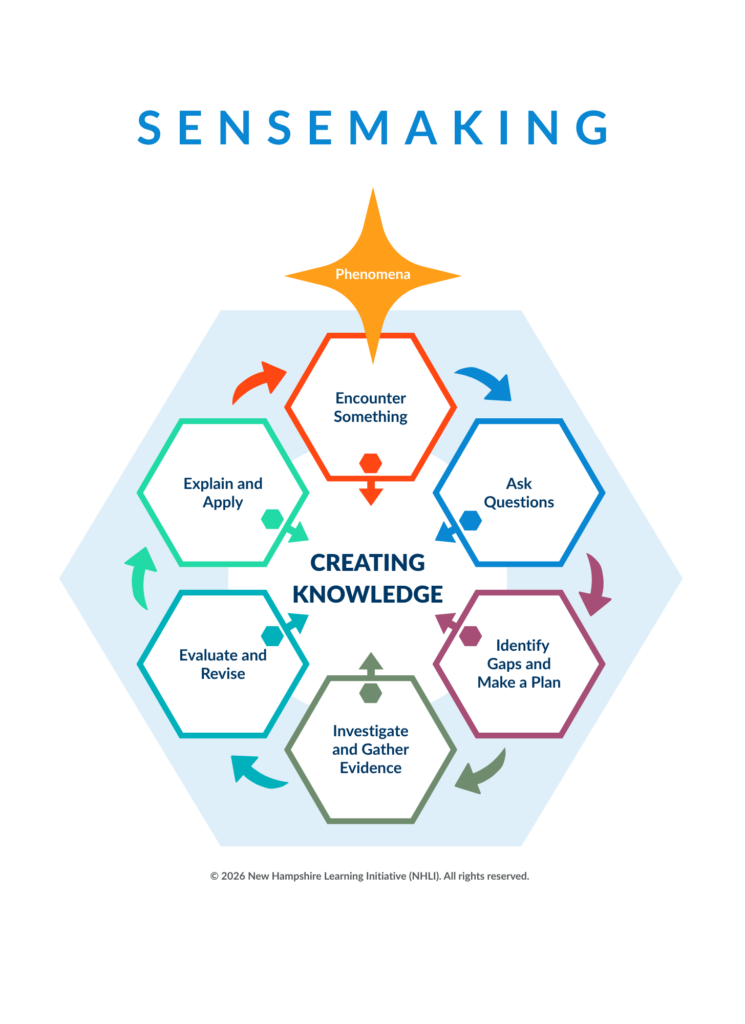
The sensemaking process makes this possible. TJ McKenna states that “sensemaking is a cognitive and socio-cultural process through which individuals actively interpret information or experiences to develop coherent and meaningful understandings of complex and ambiguous phenomena.” This is not an abstract process. It shows up in how students’ ideas change over time.
Beginning with what students currently think and what they don’t know, they then draw on new information and experiences and develop more complete explanations. Along the way, they explain their reasoning, learn from one another, respond to feedback, and reconsider ideas that do not fit the evidence. Wrong answers and uncertainty are not simply problems to eliminate; they can become productive parts of learning.
Access to information is not the same as understanding it. Learning is not simply receiving information—it is building understanding.
Sensemaking matters even more in a world where students have almost unlimited access to facts and information. Knowing information is still very important, but access to information is not the same as understanding it. Students need to understand relationships, connect evidence to explanations, and transfer what they know in unfamiliar situations. Learning is not simply receiving information. It is building understanding.
Of course, this kind of teaching is not always easy. Teachers are balancing standards, curriculum, assessment, limited time, and the very real pressure to “get through” the content. But if we want students to become thinkers, creators, and problem solvers, then our classrooms need to give them opportunities to do that intellectual work. Our role begins to shift from being the source of every answer toward designing experiences that help understanding grow.
The shift toward sensemaking does not require us to abandon what we know about good teaching. It asks us to be more intentional about when we explain, when we guide, and when we create space for students to work through ideas themselves. We can design classrooms where curiosity leads to questions, questions lead to investigation, and evidence leads to deeper understanding. If we want students to leave science class believing that they can make sense of the world around them, then we need to give them regular opportunities to do just that. That is the work I will be exploring with educators in my November workshop: NGSS, Phenomena, and the Use of Sensemaking.
Learn more about NGSS, Phenomena, and the Use of Sensemaking
Sources:
Ha, H., Chen, Y.-C., & Park, J. (2024). Teacher strategies to support student navigation of uncertainty: Considering the dynamic nature of scientific uncertainty throughout phases of sensemaking. Science Education, 108, 890–928. https://doi.org/10.1002/sce.21857
Stenger, Marianne. “Why Curiosity Enhances Learning.” Edutopia, George Lucas Educational Foundation, 17 Dec. 2014.
Loewenstein, George. “The Psychology of Curiosity: A Review and Reinterpretation.” Psychological Bulletin, vol. 116, no. 1, 1994, pp. 75–98.
McKenna, Thomas J. Making Sense of Sensemaking: Designing Authentic K-12 STEM Learning Experiences. Teachers College Press; NSTA Press, 2025.

Sue Downer
Director of STEM and Performance Learning
At NHLI, Sue provides professional development in science curriculum, instruction, and assessment. She leads the Science and Math PLACE (Performance Learning and Assessment Consortium for Educators) project. PLACE is a consortium of teachers working toward student-centered, phenomena-driven, and NGSS-aligned performance instruction and assessment.
Her experience includes co-designing and implementing professional development workshops for K-12 science teachers. Before joining NHLI, Sue spent 28 years teaching chemistry and AP chemistry at Souhegan High School in Amherst, NH. During that time, she served as the science department coordinator, senior project coordinator, and as a content lead for the NH-PACE project focused on developing performance assessments for competency-based learning.
Categories: Competency-Based Education Competency-Based Learning (CBL) Innovative Teaching Practices NHLI Blogs NHLInsights, Research and Resources Science Student-Centered Learning Teacher Professional Development