Get support for student success - right in your inbox
NHLI | New Hampshire Learning Initiative
All Students Deserve a Quality Education
/ March 20, 2026
Co-Creating Science Learning Across New Hampshire: PLACE Science Network Meeting
Estimated reading time: 5 minutes
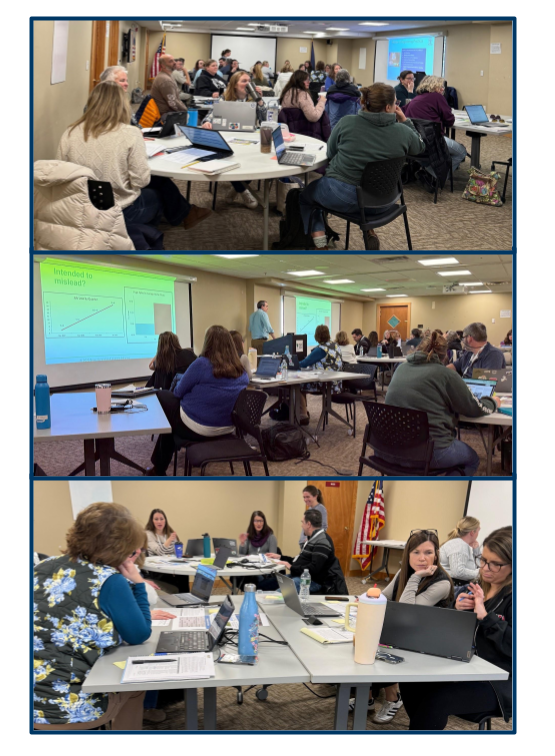
On a cold February morning at the NHED, science educators from across New Hampshire gathered with a shared purpose: to strengthen how students experience science in classrooms statewide. The February 3rd PLACE Science K–12 network meeting was more than a typical professional development day. It was a working session grounded in collaboration, curiosity, and the ongoing shift toward three-dimensional science learning. From the moment participants arrived, the tone was clear—this was a space for co-creating knowledge, not simply receiving information.
This is the final in our series of blog posts featuring the high-caliber work of our PLACE educators. You can read the previous posts at these links: ELA in Action and Making Math Spicy
Starting with Curiosity
Learning begins with curiosity, and classrooms should be places where students actively figure things out.
The day began by inviting teachers into the same kind of thinking we want for students. Through noticing and wondering routines, educators examined a series of timestamped photographs of the northern lights and surfaced questions together. The room quickly filled with conversation. This opening mattered. It modeled a core belief driving PLACE work: Learning begins with curiosity, and classrooms should be places where students actively figure things out. By experiencing the routine as learners, teachers were able to reflect on how these moves support student sensemaking in their own classrooms.
Experiencing the Practices
Mid-morning, the energy in the room shifted into investigation mode during the Bone Mystery activity. Teachers worked collaboratively to analyze evidence, develop claims, and engage in argument from evidence. The purpose of the investigation was to allow educators to examine the NGSS Science and Engineering Practice of “Arguing from Evidence” and the learning progression for this topic across the K-12 grade span. Around tables, you could hear the kinds of questions we hope students ask every day:
- What pattern are we noticing?
- What evidence supports that claim?
- How confident are we in this explanation?
- What would be the expectation of this activity if our students were in the 5th grade, 7th grade, or 10th grade?
The activity sparked rich discussion about how the Science and Engineering Practices must be intentionally developed across grade levels—not taught once, but spiraled and strengthened over time. Participants reflected on an important takeaway: students need repeated, meaningful opportunities to work with evidence, not just occasional exposure.
Turning Learning into Design Work
After the morning learning, the focus shifted from experiencing high-quality instruction to building it. Educators moved into cross-district grade-level teams to refine and develop phenomenon-driven performance tasks. One group dove deeply into a question that immediately captured attention: Do woolly caterpillars accurately predict the severity of the upcoming winter?
What might seem like a simple claim in folklore quickly opened the door to sophisticated scientific thinking. Teachers wrestled with:
- The difference between correlation and causation
- What counts as credible evidence
- How students might design investigations
- How to build a coherent storyline that supports sensemaking
The conversation was lively, thoughtful, and deeply grounded in classroom reality.
A Moment on Evaluating Evidence
Later in the afternoon, participants zoomed in on a critical skill for today’s students: evaluating evidence. Through quick comparisons and discussion, teachers examined how easily data and visuals can mislead if students are not equipped to question sources and reasoning. The session reinforced a growing priority across PLACE classrooms: Students must learn to critique evidence—not just use it.
The Power of the Network
This is the heart of PLACE: breaking down isolation, building shared expertise…
Perhaps the most powerful part of the day wasn’t a single activity—it was the structure of the work itself. Throughout the afternoon, teachers worked shoulder to shoulder with colleagues from different school districts, grade levels, and contexts. Ideas moved quickly across tables. Resources were shared. Assumptions were challenged in productive ways.
This is the heart of PLACE: breaking down isolation, building shared expertise, and accelerating the shift toward high-quality science instruction across the state. By the end of the work session, teams had clearer next steps and renewed momentum heading into the next meeting.
Looking Forward, Looking Back
New Hampshire educators are not waiting for the instructional shift to happen—they are actively building it together.
As the group wrapped up the day, the focus turned to what comes next. Each team identified priorities for continuing their task development and classroom implementation. What was most evident as we left the room was this: New Hampshire educators are not waiting for the instructional shift to happen—they are actively building it together. Through the PLACE Science network, that work continues to grow stronger with every convening.
The Performance Learning and Assessment Consortium for Educators (PLACE) series has highlighted a fundamental shift in New Hampshire education—one that moves beyond traditional, one-day workshops to create a sustained, teacher-led community of practice. Whether through “spicy” math strategies that build student persistence, ELA assessments grounded in trust and authentic evidence, or science investigations driven by genuine curiosity, the work of this consortium remains centered on a single goal: ensuring every student has the opportunity to think, reason, create, and apply their learning in meaningful ways. By breaking down professional isolation and building shared expertise across districts, PLACE educators are collectively reimagining student engagement, assessment, and agency for the modern classroom and improving their individual practice through the collaborative process.
We invite you to stay connected with this journey as the New Hampshire Learning Initiative continues to support personalized and performance-based learning throughout our state. To learn more about the impact of this work or to initiate a conversation with our team about your district’s specific goals, please visit our Contact Page.

Sue Downer
Director of STEM and Performance Learning
At NHLI, Sue provides professional development in science curriculum, instruction, and assessment. She leads the Science and Math PLACE (Performance Learning and Assessment Consortium for Educators) project. PLACE is a consortium of teachers working toward student-centered, phenomena-driven, and NGSS-aligned performance instruction and assessment.
Her experience includes co-designing and implementing professional development workshops for K-12 science teachers. Before joining NHLI, Sue spent 28 years teaching chemistry and AP chemistry at Souhegan High School in Amherst, NH. During that time, she served as the science department coordinator, senior project coordinator, and as a content lead for the NH-PACE project focused on developing performance assessments for competency-based learning.
Categories: Competency-Based Education NHLI Blogs NHLInsights, Research and Resources PLACE (Performance Learning and Assessment Consortium for Educators) Science Teacher Professional Development